Search This Blog

Showing posts with label Low Back Pain. Show all posts

Tuesday, 10 April 2012

Posture, Vibration, and Back Pain in Truck/Heavy Equipment Operators

               Equipment Operators and Truck Drivers are an essential part of any construction team.   Even though these people tend to spend much more time sitting down, they often are the ones who present to my office with Low Back Pain.  Not only does sitting for extended periods lead to Low Back Pain, as in Office Workers, Operators and Drivers also experience constant vibration.  This vibration combined with prolonged sitting is what makes operating heavy machinery worse than sitting at a desk.

                First of all, maintaining good sitting posture will help prevent Low Back Pain associated with this type of work.  Having an adjustable seat with suspension to minimize vibration, and properly placed controls is important.  However, these things are both out of the control of the worker and often not cost effective to change.

Here are a couple quick and inexpensive tips to help improve your posture.

1.)    Add Lumbar Support

Posture supports can be purchased at most Pharmacies and Big Box Stores.  Ideally, the Low Back support should be adjustable to accommodate different body types and preferences

2.)    Use a Seat Cover

The seats in Construction Equipment are commonly made of non-breathable materials such as synthetic leather.  The problem with using this type of material is that they allow you to slip forward, which promotes poor posture.  A breathable, non-slip material will prevent this and make it easier to keep your low back against your back rest. 

3.)    Reach with your arm, don’t lean.

While concentrating at the task at hand, it is easy to start leaning over towards the levers or gear shift so they are closer.  Leaning to one side for extended periods, especially when combined with vibration, can be damaging to your spine.  Sit up straight so that the centre of your chest is directly above the centre of your seat. 


                As mentioned above, vibration adds a unique problem for equipment operators.  A certain amount of vibration is unavoidable; however there are a few things than can be done to minimize it.

1.)    Regular Maintenance

Equipment maintenance and driving surface conditions can contribute to the amount of vibration experienced by the driver.  Ensure equipment is well maintained and haul roads are also maintained.  Also, particularly rough areas should have signage so that drivers can adjust their speed. 


2.)    Operator Behaviour

Techniques such as reducing driving speed and taking rest pauses throughout the day can minimize vibration exposure.  A recent document published by the Alberta Government in 2008 suggests rest breaks of 10-15 minutes per 2 hours of exposure


These strategies can help to prevent injury.  If you already have Low Back Pain, you should consult a licensed Chiropractor for treatment and advice. 


Dr. Jeff Marshall, BScKin, DC

Back Home Chiropractic, Goulds, NL
747-0844

Thursday, 16 February 2012

NL Construction Magazine Article

The following article appeared in the January issue of the NL Construction Magazine:

Low back pain (LBP) is a very common problem on the construction site.  In fact, about 80% of people will experience at least one episode of LBP in their lifetime.  Not only does LBP affect our ability to play with our kids and to do things around the house after work, but LBP is one of the most common reasons for lost time at work.  In the US, over $100 billion is spent both directly and indirectly due to Low Back Pain each year.  This is a huge number but we all know that WHSCC costs, loss of skilled workers, finding replacement labour, and direct medical costs can add up fast.  Not to mention the personal cost to the one who is injured.  For these reasons, it is important that the prevention of these types of injuries is in focus; not only for employers and Health and Safety personnel, but with each individual worker.
When treating Low Back Pain, I always recommend exercises for the spine.  For patients who have strenuous jobs like those in the construction industry, this comes as a surprise.  They all have very strong backs, and are used to lifting heavy loads.  However in the large amount of research done on low back pain, poor endurance has been shown to lead to more LBP than poor strength.  The reason for this is the large muscles responsible for lifting things are separate than those small muscles that hold the back stable and your spine in line as you go about your day.  If these small muscles become fatigued, you will be more at risk of an injury because your spine will not be properly braced to do the work it needs to.       
To increase the endurance of the spinal stabilizers, it is best to train them by holding a neutral spine for increasing periods of time.  Here are a couple great, and simple, exercises for training your spinal stabilizers
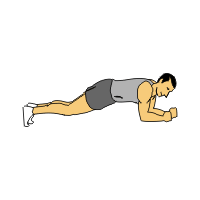
Front Plank

Get down on the floor, face down.  Come up on your toes and forearms, like in the picture below.  Keep your stomach pulled in, stomach muscles tight, and breathe normally.  Hold this position until you start shaking a lot, or you feel like you are unable to keep your hips on a straight line from your head to your feet. Hold this position for 30 seconds for three sets.
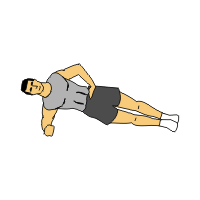
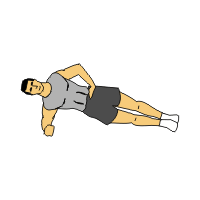
            Side Plank

Laying on your side and resting on your forearm, lift your hips up so that only your forearm and your lower leg touches the ground.  Keep your stomach pulled in, stomach muscles tight, and breathe normally.  Imagine a straight line going from your nose to your belly button, that is how high your hips should be.  Hold this position until you start shaking a lot or you are unable to hold your hips up any longer.  Once you can hold this for three sets of 30 seconds, progress a full side plank by only allowing your feet and forearm to touch the ground. 

Bird Dog

Kneel on the floor with your hands placed firmly about shoulder width apart.  Keep your stomach pulled in, stomach muscles tight, and breathe normally.  Practice lifting one hand and the opposite knee an inch off the floor while balancing on the other hand and knee.  Once you get the hang of it, point one arm straight out front and extend the opposite leg to the rear.  Hold this position for 10 seconds and then alternate sides.  Repeat this three times

Any questions or concerns?  Give us a call at 747-0844
Dr. Jeff Marshall, BScKin, DC

Monday, 28 November 2011

Practice Safe Snow Removal

When you consider that a shovelful of show weighs 5-7 pounds (often more with our wet snow!), you quickly realize how much weight you need to move to clear your sidewalk or driveway.  Shoveling snow can be a pain in more ways than one.  Here are some tips to help keep your back in top shape this winter.

Don't Let the Snow Pile Up:
If the weather report calls for an extended period of snowfall, its tempting to just wait until the snow stops to shovel.  However, frequent shoveling witll allow you to move smaller amounts of snow at once. This will be far less strenuous in the long run.

Pick the Right Shovel:
Use a lightweight pusher-type shovel.  In situations where a small metal shovel is better, try spraying it with Teflon to keep snow from sticking to it. 

Push, Don't Throw:
Always push the snow to the side rather than throw it.  That way you avoid lifting heavy shovelfuls of snow, and sudden twisting or turning movements.  If you are piling snow up and need to lift it, walk the snow over the the pile and place it on top instead of throwing. 

Bend Your Knees:
As in any lifting activity, you need to use your knees, leg, and arm muscles to do the pushing and lifting.  While doing this, keep your back straight.

Take A Break:
If you feel tired or short of breath, stop and take a rest.  Your back is much more prone to injury when you are out of breath.  Stop shoveling immediately if you feel chest pain or back pain.

If you have back pain that is severe, or presists for more than a day after shoveling, give us a call at Back Home Chiropractic.  If you start to have chest pain that is severe, see a medical doctor immediately.

Dr. Jeff Marshall, BScKin, DC

Thursday, 27 October 2011

Wear it Light, Pack it Right!

Many kids wear backpacks daily.  Whether you are heading out after school with the kids or sending them off to school, theres a good chance they will be wearing a backpack.

You are probably carrying something as well.  Maybe its a purse, a suitcase, or your own backpack Knowing how to choose, pack and lift backpacks, shoulder bags and luggage can prevent them from becoming a pain in the back.

These CCA approved guidelines will help to spare your back:

BACKPACKS

Choose carefully: Go for lightweight vinyl or canvas. Pick a pack that has two wide, adjustable and padded shoulder straps, along with a hip or waist strap, a padded back and plenty of pockets.

Pack it properly: Make sure the backpack contains only what is needed for the day or the activity. Distribute the weight of the contents evenly. The total weight of the filled pack should be no more than 10 to 15 per cent of the wearer’s body weight.
Wear it right: Both shoulder straps should always be used, and adjusted so that the pack fits snugly to the body without dangling to the side. Never sling a backpack over one shoulder. You should be able to slide a hand between the backpack and the carrier’s back.

It’s a fact! More than 50 per cent of young people experience at least one episode of low back pain by their teenage years. Research indicates one cause is improper use of backpacks. So pack it light and wear it right!

SHOULDER BAGS

Choosing a Shoulder Bag: Whether your bag is a purse or home to your laptop, choose one with a wide, padded adjustable shoulder strap.

Packing a Shoulder Bag: Divide the contents among multiple pockets to help distribute the weight and keep items from shifting. Your bag should not weigh more than 10 to 15 per cent of your body weight.

Carrying a Shoulder Bag: Don’t always carry your bag on the same shoulder, switch sides often so that each shoulder gets a rest. Try not to lift the shoulder on which the purse is carried, ideally wear the strap across your chest.
LUGGAGE

Choosing Luggage: Look for sturdy, light, high-quality and transportable pieces. Avoid purchasing luggage that is already too heavy when empty. Choose a bag with wheels and an adjustable handle when possible.

Packing Luggage: Over-packing is a pitfall. Ensure your luggage is never too heavy for you to pick up.

Lifting Luggage: Place carry-on luggage into the overhead compartment by first lifting it onto the top of the seat. Use your knees, not your back to lift!

The Last Word: Carrying a heavy load that is poorly distributed can cause a number of problems including muscle strain, headaches, neck, back and arm pain, and even nerve damage. It pays to pack it light and wear it right.

These simple tips will help prevent back pain due to backpacks, purses, and/or lugagge.  If you have any questions or concerns, please contact us at 747-0844 or stop by the clinic in Bidgood's North Plaza in The Goulds. 

Dr. Jeff Marshall, BScKin, DC, CSCS

Monday, 8 August 2011

Training Your Abs and Core For A Healthy Back

When people start going to the gym, often having a fit midsection is among their goals.  However, the most common types of exercises that people do for their abs are not healthy for their spines.

 While at the gym, the two most common exercises I see people do are crunches with rotations (touching your elbow with the opposite knee) and side bends (where you bend to the side while standing with a weight in your hand). 

These exercises will certainly work the core muscles.  The issue with these exercises, and others that involve repetitive movement of the spine, is that they place alot of pressure on the discs over many repititions.  The movements that place the most stress on the discs are flexion (bending forward), rotation, and compression.  Both the Side Bend, and Crunches (along with similar exericses) create exactly these type of forces.  Over time, these repetitive strains on your discs can lead to injury.

When you think of the main function of your abs and other core muscles, it isnt to repetitively flex or bend.  It is to hold your body upright and stable for long periods of time.  Research into low back pain has shown that the endurance of spinal stabilizers is one of the most important factors to be addressed in maintaining spinal health.  In order to train endurance, while minimizing stress on the spine, I always recommend training abs in a neutral position.  The four exercises I most commonly recommend for this purpose are the Bird-Dog, Dead-Bug, Front Plank, and Side Plank.

1. Bird-Dog
- Pull your belly button down and brace your abs
- Breathe normally throughout exercise
- Concentrate on holding a neutral spine and not allowing it to move
-Hold position shown for 1-2 seconds, then slowly alternate and repeat
- Perform 10-15 repetitions on each side for three sets every other day.  If you reach a point where you can no longer maintain a neutral spine, its time to end that set.

2. Bird- Dog

- Kneel on all fours and pull in your belly button
- Raise your right arm and left leg and hold for 5-10 seconds
- Breathe normally
- Repeat on the same side three times, then alternate
- Concentrate on keeping your back flat, and not allowing your hips to rotate

3.  Front Plank
- Hold your belly button in
-Hold this position for as long as proper form can be maintained. 
- Breathe normally while keeping your belly button in and abs tight

4. Side Plank
- Hold your belly button in
- Breathe normally while keeping your belly button in and abs tight
- Make sure to keep your body straight.  ie. Your hips in line with your shoulders when looking from the front and from above.

As I said, these are the four exercises I most commonly recommend to train spinal stability.  These exercises are useful for people of all fitness types.  However, it is important for those with existing back problems to consult a professional before starting these types of exercises.  These people may benefit from treatment and/or starting at a more basic level. 

If you have any questions or would like to book an appointment, please call us at 747-0844

Dr. Jeff Marshall, BScKin, DC, CSCS
Chiropractor
Contemporary Medical Acupunture Provider
Certified Strength and Conditioning Specialist